
Welcome to the second edition of the Brainwrap Newsletter! I'm happy to report that the feedback about both the newsletter as well as the new website has been overwhelmingly positive (and the criticism to date has been both kind-hearted and helpful).
I'm also happy to announce that most of the content from each newsletter--along with other tips, hints and general musings on all things website-related--will be reposted online via the new Brainwrap Blog.
Newest Client: ST. EPHREM CATHOLIC COMMUNITY
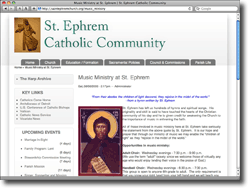
"In the winter of 372-373, a famine gripped the city of Edessa (now Urfa, Turkey). There was some food left in the city, but it was in the hands of a few wealthy individuals. The excuse they gave for not sharing the food was that no one could be found to distribute it fairly or honestly..."
So begins the tale of the St. Ephrem Catholic Community Church on Dodge Park Rd. in Sterling Heights, Michigan.
St. Ephrem Catholic Community features the Drupal 6.15 Content Management System.
Featured Client: TUTTO BUONO

Unique Italian Gourmet Specialties: Italian gourmet foods, Italian gourmet gift basket and Imported Italian food gifts.
"After having spent years searching for the top-quality Italian food specialties I grew up with and those that I had heard about from my Italian-born parents, it was clear there was a need to find and provide unique, all-natural Italian food specialties. This site is dedicated to my parents and the love of food and family that they passed on to their children." --Maria-Teresa Cozzolino, Owner
TuttoBuono.com features a customized version of the Miva Merchant 5.5® ecommerce / shopping cart system.
Website Services: BLOGS
"A blog (a contraction of the term "web log") is a type of website, usually maintained by an individual with regular entries of commentary, descriptions of events, or other material such as graphics or video. Entries are commonly displayed in reverse-chronological order. "Blog" can also be used as a verb, meaning to maintain or add content to a blog." -- Wikipedia
Even if you're fairly new to the online world, you've probably started hearing this funny-sounding word thrown about. "Blog" is just a shortening of "Web Log", and generally refers to an online journal or diary. Technically speaking, any website which is updated frequently could fall under this definition, but blogs generally have several specific features which distinguish them from other websites: First, they're usually updated fairly regularly with stories, articles, essays & ideas of the day by the owner(s) of the website; second, they're generally interactive, featuring the ability for visitors to provide feedback comments which appear directly on the blog site for other visitors to also read and respond to (similar to a Message Board). Finally, blogs usually have a more casual atmosphere than the typical corporate/business website, and generally reflect the personalities or personal viewpoints of the owner(s).
From a technical standpoint, a blog is really just a stripped-down content management system, as it provides the means for both the website owner(s) as well as website visitors to add, delete or edit content (usually text, but sometimes photos or other content as well) directly through the web interface, without having to know or learn a lot of HTML coding or file upload programs.
There are numerous open-source blogging tools available on the web. Feel free to call me at 248 545-7570 or email cgaba@brainwrap.com to help you find the right blogging solution to get you started!
Feature Essay: ONLINE PRIVACY
If you know anyone living in Pennsylvania--or if you just happen to follow such things--you probably heard something about the Great Lower Merion School District WebCam Scandal of 2010®, otherwise known as WebCamGate.
For those who haven't heard about this incident, the nutshell version is that a school district in Pennsylvania has, for the past few years, participated in a "one-to-one" laptop computer educational program throughout their high schools. Every high school student throughout the district is given a laptop to either replace or enhance the traditional textbook curriculum, giving them the ability to do homework, write essays, do online research and so forth while also learning more about the use of technology in the classroom. These sorts of programs are becoming more and more common throughout the country as schools try to tear down the "digital divide" between wealthier and less-fortunate students, giving everyone equal access to the tremendous amount of information and power of the web.
Obviously handing out thousands of expensive laptop computers to teenagers also brings with it the potential for loss, theft and damage, which is why any properly-implemented version of a "one-to-one" program will include a carefully thought-out policy for preventing or correcting these problems. Lower Merion does indeed have such measures, including a mandatory insurance purchase requirement and strict rules about maintenance, inventory control and so forth.
Unfortunately, it turns out that they also had one additional theft/loss-protection method...which they failed to tell either the students or parents about: 24-hour a day, remote access to the laptops' built-in webcams, even when the laptops were off the school grounds. The school district apparently had the ability to turn on the cameras of any laptop at any time, regardless of whether the computer was on the school's network or the students' home ISP. If the laptop was turned on and online, the school could turn the built-in camera on, in most cases without the student ever knowing about it.
This part of the program was only made public recently, when one 15-year-old student and his family discovered the remote-surveillance capabilities and filed a lawsuit against the school district. Since then, the story has quickly spread all over the web and the news media. County prosecutors are investigating wiretap/privacy laws. Federal prosecutors have issued subpoenas and the FBI has gotten involved, as has the ACLU.
While this could certainly be effective in helping to locate a lost or stolen computer, it also should have also sent a huge red flag up to anyone involved in the decision-making process. The instant they realized they were talking about the ability to effectively install secret cameras in the bedrooms of high school students, they should have dropped that particular portion of the program like a hot potato.
Now, I'm not writing about this to try and scare anyone out of participating in similar programs. Not every laptop has a built-in webcam, and my guess is that most schools running "one-to-one" laptop initiatives don't have such software installed. Those which do are, for the most part, wise enough to restrict such capabilities to within the school network itself, and even they are probably scrambling to rethink the use of remote webcam software in the wake of the Lower Merion case.
HOWEVER, this case does highlight the importance of being aware of the fact that, whether it is actually being monitored or not, pretty much everything that you type or do online could be being either monitored or recorded by someone, somewhere. Deleting an email from your hard drive doesn't necessarily delete it from the server. Deleting it from the server doesn't necessarily delete it from your ISP's (or hosting service's) backup copy. And even if all of those copies are gone, that doesn't necessarily mean that the person who you sent the email to (or who sent it to you) deleted every copy they had--or that they haven't forwarded it on to one or a thousand other people. And even if every copy from everywhere has been deleted--there are any number of ways of restoring data from a hard drive even after it's been "deleted".
The same holds true of instant messages, Twitter or Facebook posts, and (as former Detroit Mayor Kwame Kilpatrick infamously discovered) mobile phone text messages.
Does this mean you should be paranoid? No. Not all personal information is easy for third parties to access, and doing so may be illegal, so this doesn't mean that everyone in the world is spying on you; the odds are that few, if any, actually are.
What it does mean is that you should use common sense when posting information online, just as you should anywhere else. You shouldn't shout out your credit card or social security numbers on a crowded bus, and getting undressed on your front lawn probably isn't a wise thing to do; similarly, use care when you post sensitive financial or personal information online. Making extreme political or social statements can lead to awkwardness at the office or around the dinner table--similarly, posting a political diatribe on Facebook can lead to unintended consequences if your boss, other co-workers or family members have been "Friended".
In short, say whatever you want to say--just remember that your words may be read by more people than you intended, and proceed accordingly.
That (brain)wraps up this edition. I welcome your feedback and, as always, appreciate your business.
--Charles


